
How to Start a Home-Based Jewelry Making Business on a Small Budget
Pick a technique, buy a lean starter kit, price with a formula and find the buyers for handmade jewelry you make at home.
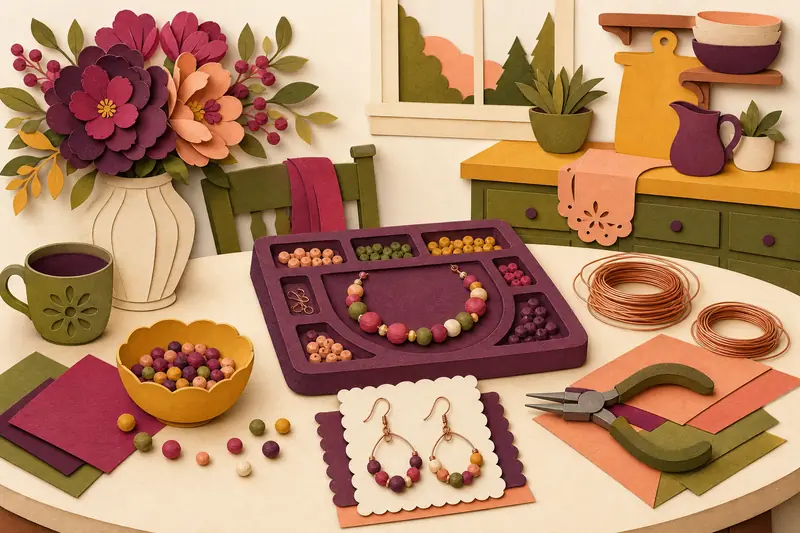
Jewelry is one of the easiest crafts to turn into a home business. The pieces are small, the supplies fit in a tackle box, you can work at the kitchen table while dinner simmers, and a pair of earrings ships in a padded envelope. The catch is competition. At almost any craft fair you will find three or four jewelry tables, so the business depends on making pieces that look like yours and nobody else’s.
Pick one technique to start
Each method has a different cost, learning curve and look. Most sellers begin with one and add a second later.
| Technique | Starter cost | Learning curve | Typical look |
|---|---|---|---|
| Beading and stringing | Low | A weekend | Colorful, casual, fast to make |
| Wire wrapping | Low | A few weeks | Organic, handmade feel, works with stones |
| Metal stamping | Moderate | A few weeks | Names, dates, personalized pieces |
| Polymer clay | Low | A few weeks | Bold shapes and colors, very light |
| Silversmithing and soldering | Higher | Months | Fine jewelry, higher prices |
Beading and wire work are where most people start, because free video tutorials and library books cover the basics well. Metal stamping deserves a second look if you like selling at fairs: personalized pieces sell well, and stamping a name while the customer waits gets attention from the aisle.
A lean starter kit
Resist the big “complete kit” bundles. Buy what one small collection needs:
- Round-nose, chain-nose and flat-nose pliers, plus wire cutters
- Wire in one or two gauges, in a single metal color to begin
- Findings: ear wires, jump rings, clasps, crimp beads
- Beads or stones for two or three color stories
- Earring cards, small bags and a notebook for tracking costs
Buy ear wires in hypoallergenic metals such as sterling silver, niobium or surgical steel if you can. Many buyers react to nickel, and “these won’t make your ears itch” is a real selling point. Only describe a piece as nickel-free when your supplier states it.
Price it so the business pays you
Handmade jewelry is often priced at the cost of the beads, which leaves nothing for your time. A simple formula works better:
Materials + labor + a small overhead share = cost. Cost x 2 = retail.
Take a pair of wire-wrapped stone drop earrings:
- Materials: two stones, wire and sterling ear wires, $2.80
- Labor: 20 minutes at $15 an hour, $5.00
- Overhead (cards, bags, tool wear), $0.45
- Cost: $8.25, so retail is $16.50, rounded to $18
At $18, you earn your hourly rate, cover packaging, and still have room to sell to a boutique at a wholesale price later. If the same earrings would need to sell for $40 to cover your time, look for a faster method or cheaper materials before raising prices.
Build a price range: a few $10 to $15 pieces for impulse buys, most items between $18 and $40, and a handful of statement pieces above that.
Where to sell
Craft fairs and holiday markets. Buyers can try things on, which matters for jewelry more than almost any other craft. Bring a hand mirror, display earrings at eye level and keep your cheapest pieces near the front. The guide to selling at craft fairs walks through booth setup, packing and show-day selling.
Online. Handmade marketplaces, your own site, or eBay for vintage-style and supply lots. Good photos decide online sales: shoot in daylight near a window, on a plain background, with one photo showing the piece on a person for scale.
Trunk shows and home parties. A friend hosts, invites a dozen people and gets a free piece or a discount as thanks. Low cost for you and a warm crowd.
Boutiques and gift shops. Expect to sell wholesale, often at around half your retail price, or on consignment, where the shop pays you after a piece sells. Get the terms in writing.
The paperwork
Treat it as a real business from the first sale. Most states require a seller’s permit to collect sales tax, and many cities want a business license for home businesses. Keep receipts for every supply order, because craft income is taxable and your costs reduce what you owe. The IRS small business and self-employed center explains the basics.
If you make pieces for kids, be careful. Children’s jewelry falls under Consumer Product Safety Commission limits on lead and other metals, and the testing requirements can be a lot for a one-person shop. Many home jewelers simply design for teens and adults.
Display and packaging on a budget
Presentation does a lot of selling for jewelry, and it does not need to cost much. Earring cards can be printed at home on card stock and cut with a paper trimmer; add your shop name and a line about the materials. A thrifted picture frame with chicken wire or a strip of burlap stapled inside holds a dozen pairs of earrings upright at a fair. Old teacups, small wooden bowls and a bread board make good trays for rings and bracelets.
Package each sale so it feels like a gift, since many buyers are shopping for someone else. A small organza bag or a kraft paper box with a sticker costs a few cents and makes the piece look worth its price. Tuck in a card with basic care instructions, for example to keep sterling silver dry and store it in a zip bag to slow tarnish.
Keep a small repair kit in your bag too. Customers sometimes come back with a broken clasp or a bent ear wire, and fixing it on the spot for free earns more loyalty than any advertising.
Keep production moving
Batch your work once a design proves itself. Cut all the wire for 20 pairs at once, then form all the loops, then attach all the stones. Working in stages cuts your time per piece and makes your labor cost in the pricing formula drop. Keep a small notebook entry for each design with its materials, measurements and time, so you can make the same piece again months later without guessing.
Make it recognizably yours
Look at what the other jewelry sellers in your area make, then do something else. A signature element (one wire-wrap style, a color palette, a type of stone, hand-stamped initials) turns a table of pretty things into a brand people remember. Your top sellers will tell you which direction to push, so keep a tally of every sale.
The sections on which crafts sell and the survival tips for a craft business cover building a focused product line and keeping supply costs down. Start with 30 pieces in one style, take them to one show, and let the tally sheet pick your second collection.
Questions, answered
How much does it cost to start a jewelry making business?
A beaded or wire jewelry line can start for roughly $100 to $200: three or four pairs of pliers, wire, findings, a bead assortment and display cards. Metal stamping and silversmithing cost more because of the tools. Start with one technique, buy supplies for one small collection, and expand only once pieces are selling.
Can you sell handmade jewelry from home without a license?
Rules depend on your state and city, and they apply to online sales as well as fairs. Many cities require a general business license for any home business, and most states require a seller's permit to collect sales tax. Check with your city clerk and your state department of revenue before your first sale.
Where is the best place to sell handmade jewelry?
Craft fairs and holiday markets are the easiest start, because buyers can try pieces on. After that, many makers add an online shop, home trunk shows with friends, and local boutiques that buy wholesale or take pieces on consignment, which puts your work in front of shoppers every day.