
Selling at Craft Fairs: Booth Setup Tips, Pricing and What Sells Best
How to pick the right shows, price your work with a simple formula, set up a booth that sells and pack for show day.
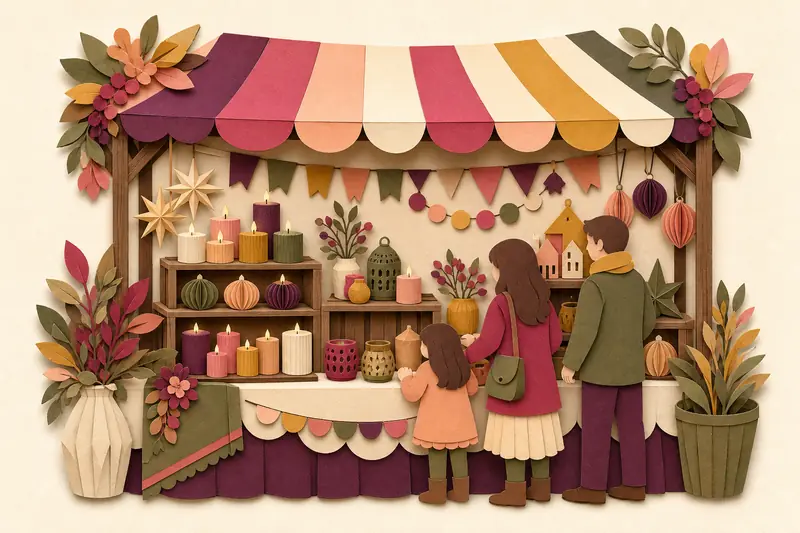
Selling at craft fairs is one of the few ways to run a real shop without signing a lease, and the fastest way to learn what sells best at craft shows. You pay for a weekend, set up a scaled-down store, meet a few hundred shoppers face to face, and pack it all back into the car on Sunday evening. When it is over, it is over. There is no monthly rent and no contract, and the customers tell you within an hour which pieces they love and which ones they walk past. No trend report teaches that as quickly for your own town.
That instant feedback is the real value for a beginner. A booth is a test kitchen for your prices, your designs and your display. Change one thing between shows, like dropping a price by $4 or moving your best seller to eye level, and you will see the result in your cash box.
Is selling at craft fairs worth it for a small budget?
It depends on math more than talent. Before you pay any booth fee, estimate what the show will cost you and how many items you must sell to cover it. Here is a typical small-town holiday show:
| Expense | Amount |
|---|---|
| Booth fee (10 x 10 space) | $120 |
| Gas, round trip | $25 |
| Parking and lunch | $15 |
| Total cost of the day | $160 |
If your average item sells for $18 and costs you $3.40 in materials, each sale puts $14.60 toward that $160. You need 11 sales just to break even, before you have paid yourself a cent for the hours you spent making the stock. Sell 40 items and the day clears roughly $424 after materials and show costs. Sell 8 and you went home $43 poorer.
Run that calculation for every show you consider. It takes two minutes and saves more money than any display trick. It also tells you something useful about your product line: if your cheapest item is $60, you will need a crowd that came to spend, and a small school bazaar will not supply one.
Two more things work in your favor when selling at craft fairs. Shows mostly happen on weekends, so your weekdays stay free for making inventory, and nearly every dollar a customer hands you is yours. There is no shop taking a 40 or 50 percent cut the way a consignment store or wholesale account would.
How to find craft fairs to sell at
Most new sellers find their first show by accident, usually a church bazaar a friend mentioned. A better plan is to build a list of 10 to 20 possible events and then pick the few that match your prices. Here is how to find craft fairs to sell at without paying for a pile of directories:
- Local calendars. City and county parks and recreation departments, public libraries and the chamber of commerce all post community events. Holiday bazaars at churches, schools and fire halls often appear only there.
- Facebook groups and Instagram. Search your town or county name plus “craft fair,” “maker market” or “vendor.” Local vendor groups share open calls and last-minute cancellations, which are an easy way into a full show.
- Farmers markets. Many accept a few craft vendors, and weekly markets let you test products at a low daily fee.
- Your state arts council and arts agencies. They list juried art fairs and festivals, especially the larger summer events.
- Show listing sites and magazines. Sunshine Artist has covered the art and craft show circuit for decades and publishes show listings and reviews.
- Other vendors. Walk a show as a shopper and ask sellers, politely and when they are not busy, which events were worth it this year. Ask what they would skip too.
Once you have the list, check each event before you apply. The best research is to visit it the year before. If that is impossible, ask a friend who lives nearby or lean on vendor reviews. Try to answer these questions:
- How many booths are there? A show with 200 vendors draws a bigger crowd than one with 20, though it also means more competition.
- Is it indoors or outdoors, and has bad weather hurt attendance in past years?
- How does the organizer advertise? Look for yard signs, radio, local news listings and an active social media page.
- What security is there overnight at a two-day event? Many outdoor shows have none, which means packing up your stock each evening.
- What do the other vendors sell, and at what prices? This question matters most.
Choosing the right kind of show
The type of event decides who walks through the door and how much they expect to spend. Matching your prices to the crowd matters more than finding the biggest show.
| Show type | Typical buyer spend | Good fit for |
|---|---|---|
| Church, school and community bazaars | $5 to $30 per item | Ornaments, baked goods, kids’ gifts, small home décor |
| Country craft shows | $2 to $50 per item | Handmade gifts, seasonal décor, practical items |
| Juried art and craft fairs | $40 to several hundred | Pottery, fine jewelry, woodwork, fiber art |
| Farmers and maker markets | $5 to $40 per item | Consumables like soap, candles, jams where allowed |
| Mall and holiday pop-up shows | $10 to $60 per item | Gift-ready items in November and December |
Juried shows usually pay best for higher-priced work. A jury reviews photos of your pieces, and often your booth, and picks the best applicants, which screens out kit crafts and imports. Many big shows take applications three to six months ahead and charge a jury fee that you do not get back if you are turned down. Being rejected once is normal. Apply again with sharper photos.
Country craft shows and bazaars are the opposite. Entry is easy and the shoppers are friendly, but they carry $20 bills, not credit limits. A $180 quilted wall hanging will get compliments there and very few sales.
Booth tips that make people stop
Most shows sell space as a 10 by 10 foot square. You get about three seconds of attention as a shopper walks past, so the booth has to explain itself from the aisle. These booth tips come up again and again among sellers who do well:
- Build height. Flat tables are easy to walk past. Use crates, risers, a small bookshelf or a ladder shelf to lift products toward eye level.
- Cover the table to the floor. A fitted or floor-length tablecloth hides your storage bins and makes even a folding table look finished. Solid colors beat busy prints.
- Show your name clearly. A banner or sign that is readable from 15 feet away. Put your price and your product type on it if they are not obvious.
- Price everything. Many shoppers will not ask. Small tags or one clear sign per group (“All candles $18, two for $32”) remove the awkwardness.
- Leave an open way in. An L or U shaped layout invites people inside, while a single table across the front turns the booth into a wall.
- Bring your own light for indoor shows. Gym and convention hall lighting is flat and dim. A few clamp or battery LED lights make jewelry and glass sparkle.
- Weigh down outdoor tents. One gust can turn a canopy into a kite. Many outdoor shows require weights on every leg, so read the vendor rules and bring them.
Practice your full setup once in the driveway or living room. Time it, take a photo from 10 feet back, and fix what looks cluttered. You will also discover which bin you forgot to pack.
The packing checklist
Print this list and tape it inside your supply bin. Check it the night before, not the morning of.
Display and booth
- Canopy (outdoor), weights, tables, floor-length tablecloths
- Risers, crates, racks, easels, mirror (for jewelry, hats and scarves)
- Banner or sign, price tags, small signs for bundles
- Extension cords, power strip and lights for indoor shows
Selling
- Card reader, charged phone and a portable battery
- Cash box with about $100 in small bills and coins if your prices end in cents
- Bags, tissue paper, a receipt book
- Business cards or flyers with your website or shop link
- An email sign-up sheet or a QR code that leads to one
Repairs and comfort
- Toolbox: scissors, duct tape, zip ties, pliers, screwdriver, string, clips
- Small sewing kit and glue for last-minute fixes
- Folding chair or stool, water, packed lunch and snacks
- Layers, rain poncho and sunscreen for outdoor events
Pricing your work: a simple formula
Underpricing is the most common mistake in selling at craft fairs, and it hurts twice: you earn less, and shoppers read a low price as low quality. Use a formula instead of a guess.
Materials + labor + overhead = cost. Cost x 2 = retail price.
Here is a hand-poured soy candle in an 8-ounce jar:
- Materials: wax, fragrance, wick, jar and label come to $3.40
- Labor: 15 minutes at $18 an hour is $4.50
- Overhead: a share of tools, packaging and your booth display, about $0.60
- Cost: $8.50
- Retail: $8.50 x 2 = $17, rounded to $18
That doubling covers the show costs in the example above and leaves room for a wholesale price later. If a gift shop wants to carry your candles, it will expect to buy them near your cost times two and sell them at double that, so a retail price that already includes a markup protects you. Charge the same retail price at your booth that a store asks for your work. Undercutting your own store accounts is a quick way to lose them.
Now check the result against the room. If similar candles at local shows sell for $14 to $22, $18 fits. If the formula says $45 and the market says $20, you need a cheaper material, a faster method or a different show.
Offer a small spread of prices. A few impulse items under $10, a core range of $15 to $35, and one or two statement pieces that make the booth look serious. Bundles (“two for $32”) lift the average sale more reliably than discounts do.
What sells at craft fairs, and what struggles
People ask what sells best at craft shows as if there were one magic item. The honest answer is that it depends on the season, the location and the crowd. Garden items do well in spring, ornaments swell in the months before December, and tourist towns support higher prices than a suburban school gym. Still, clear patterns show up year after year.
Items that tend to sell well:
- Consumables: candles, soap, lip balm, bath salts. They get used up, so buyers come back. Keep in mind that the FDA regulates cosmetics labeling, so read the rules before you add claims like “healing.”
- Small gifts under $25: ornaments, bookmarks, keychains, coasters, magnets.
- Personalized items: names on ornaments, stamped jewelry, custom pet tags. Offering to personalize on the spot draws a small crowd by itself.
- Useful kitchen and home goods: tea towels, pot holders, cutting boards, bowl cozies.
- Pet accessories: bandanas, treat jars, collars. Pet owners rarely hesitate.
- Jewelry in the $15 to $40 range, if your pieces look different from the three other jewelry tables. The home jewelry business guide covers how to build a line.
- Baby and kids’ gifts: bibs, blankets, soft toys, following the safety rules below.
Items that struggle: anything that looks store-bought, large pieces shoppers cannot carry around for the afternoon, high-priced art at a low-priced show, and the same product half the room is selling. One year every third booth has wood signs with sayings, and the sellers who stand out are the ones doing something else.
The most reliable way to learn what sells best at craft shows in your own area is to track it. Keep a notebook at the booth and tally every sale by item and price. After three shows you will know your bread-and-butter items, and you can build the next batch around them. For a longer look at product categories and choosing a focused line, read which crafts sell.
Sales tax, permits and insurance
The legal side is not complicated, but the rules vary by state, and sometimes by county or city, so check your own before your first show.
Sales tax. Most states require sellers to collect sales tax on goods and send it to the state. That usually means registering for a seller’s permit (also called a sales tax permit or resale certificate) with your state’s department of revenue. Some shows ask for your permit number on the application. A few states, including Alaska, Delaware, Montana, New Hampshire and Oregon, have no statewide sales tax, though Alaska allows local sales taxes. If you do a show in another state, you may need to register there for that event as well.
Business license. Many cities and counties require a general business license even for a small home business. Call your city clerk or check the city website.
Food and children’s products. Selling jams, cookies or candy falls under your state’s cottage food law, which sets what you may sell, how it must be labeled, and sometimes where. Toys, clothing and other items made for children 12 and under fall under Consumer Product Safety Commission rules, so read the CPSC’s small business guidance before you sell them.
Insurance. Many shows now require vendors to carry general liability insurance, and some want to be named on the certificate. Single-event and annual policies for craft vendors are widely available and are often inexpensive compared with one booth fee.
Income tax. Craft fair income is taxable income, even at a hobby scale. Keep receipts for materials, booth fees and mileage. The IRS small business and self-employed center explains how to report it, and a tax preparer can tell you what applies to your situation.
On show day
Arrive early, set up fast, then stop fussing with the display. Stand if you can, or sit on a tall stool, so you are at eye level with shoppers instead of hidden behind the table. Say hello, then let people look. A short line that invites them to touch (“the blue ones smell like cedar”) works better than a sales pitch.
Wrap each sale quickly. The longer one customer waits for change and a bag, the more likely the next one walks off. Accept cards: many shoppers carry no cash now, and a phone card reader costs little. Keep bills in a pouch on your body, not in an open box on the table.
Collect names. Ask buyers if they want to hear about your next show, and add them to an email list. When you come back to the same town next year, a short email with your booth number brings repeat customers straight to you. Bring a packed lunch and, if possible, a helper. With two people you can take breaks, walk the show and see what others charge, without leaving the booth empty.
Weather, a bad aisle location or a quiet crowd can sink any single show. Judge an event on two tries, not one.
After the show
Sit down the next day with your tally sheet while the details are fresh. Write down total sales, costs, your best and worst sellers, the weather and the crowd size, and a yes or no on returning. That page decides next year’s applications better than memory will. After a season or two, the question of how to find craft fairs to sell at mostly answers itself, because other vendors start passing along the shows they trust and the ones that fell apart.
Leftover stock does not have to wait for the next season. Many sellers list it online; the guide to selling on eBay covers listing and shipping basics. For the business side (supplies, record keeping, sharing costs with other makers) see the survival tips for a craft business. If you love paper crafts, a scrapbooking business is another path that fits between shows, and the work from home hub collects more ideas for earning from your kitchen table.
One last habit worth starting now: photograph your booth at every show. Line the pictures up after a season and you will see which setup looked inviting and which one looked like a garage sale, and the sales numbers in your notebook will usually agree.
Questions, answered
Is selling at craft fairs profitable?
It can be, but only once you run the numbers. Add the booth fee, gas, parking and any food you buy, then divide by the profit on one average sale. If a $150 show needs you to sell 40 items to break even and the crowd is small, skip it. Many sellers lose money at their first two or three shows and learn which events fit their prices before they turn a steady profit.
What sells best at craft shows?
Small, useful and giftable items move fastest: candles, soap, ornaments, jewelry in the $15 to $40 range, kitchen towels, pet accessories and anything that can be personalized on the spot. Consumables do especially well because happy buyers come back for refills. Seasonal pieces sell hardest in the six to eight weeks before Christmas.
What should you not sell at a craft fair?
Avoid items made from kits, mass-produced imports, and anything oversized that shoppers cannot carry around for an afternoon. Juried shows usually ban kit and import items outright. Also think twice before bringing the same product half the other vendors carry, and check your state rules before selling homemade food or children's products.
How much does a craft fair booth cost?
Small church and school bazaars often charge $25 to $75 for a table. Community and holiday shows commonly run $100 to $250 for a 10 by 10 space, and large juried art fairs can cost several hundred dollars or more, plus a jury fee just to apply. Always compare the fee with past attendance before you pay.