TV-Free Activities for Kids That Cost Next to Nothing at Home
Homemade puzzles, paper parachutes, a living-room library and more screen-free ideas built from what is already in your house.
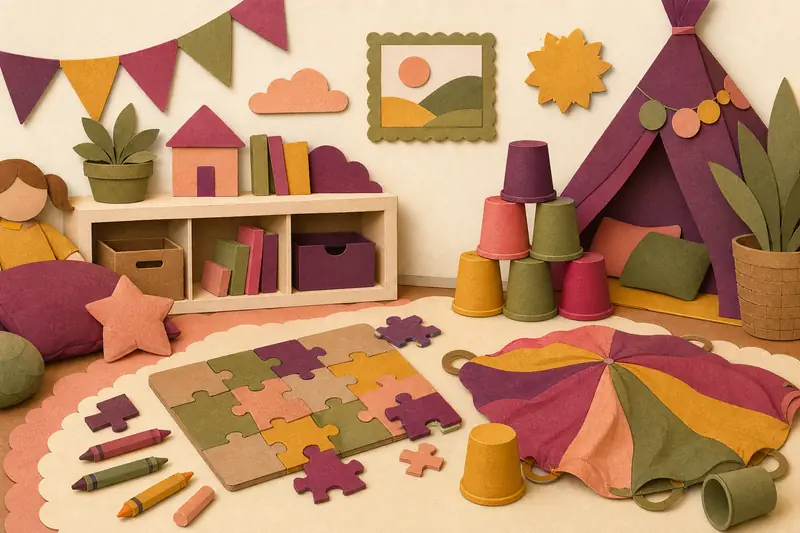
The hour after school, the stretch before dinner, a rainy Saturday: these are the times the TV goes on by default. The ideas below are meant for exactly those moments, and nearly all of them use things already in a kitchen drawer or the recycling bin. None of them needs a special trip to the store.
The American Academy of Pediatrics suggests about one hour a day of quality programming for children ages 2 to 5 and no screens except video calls before 18 to 24 months. Whatever limits your family sets, having a few ready-made alternatives makes them much easier to keep.
At the kitchen table
Homemade jigsaw puzzles. Cut a large picture from an old magazine or a cereal box, or let your child draw and color one. Glue it to a piece of cardboard, trim the edges, and cut it into pieces. Big pieces make an easy puzzle for a four-year-old, small curvy ones a real challenge for a ten-year-old. Store each puzzle in a zip-top bag.
Greeting cards. Cut a sheet of 8 1/2 x 11 paper in half and each half folds into a card. Set out markers, crayons, stickers, stamps or glitter, and ask for cards for grandparents, teachers or upcoming birthdays. It turns into a gift you do not have to buy.
Feather quill writing. Find a large feather, cut the end at a slant, and dip it into thinned tempera paint or washable ink. Writing a name with a quill is slow and messy in the best way, and it leads to good questions about how people wrote before pens.
Foil statues. Model an animal, a person or any shape from clay or play dough. Then press a sheet of aluminum foil gently over it so it clings to every curve. The result looks like a small silver sculpture.
Toothpick pick-up sticks. Hold a fistful of toothpicks upright on the table and let them fall. Players take turns removing one at a time without moving any of the others. This is a good choice for kids six and up; younger children can use craft sticks instead.
On the living room floor
Cup towers. A sleeve of plastic cups keeps younger kids building for a long time. Cups are far more forgiving than a house of cards, and knocking the tower down is half the fun. Older kids can race to build a pyramid of 10 or 15.
Handkerchief parachutes. Let your child decorate a handkerchief or a square of old fabric with markers. Tie a string of equal length to each corner, gather the strings together with a twist tie or a key ring, and hang a small toy from the bottom. Drop it from the top of the stairs or a safe spot on a porch and watch it float.
Indoor hopscotch. Mark a hopscotch grid on the carpet or hard floor with masking tape and number the squares 1 to 10. Toss a coin or bottle cap into square 1, hop through the rest, and pick it up on the way back. Then toss into square 2, and so on. Outside, the same game works with sidewalk chalk.
Blanket fort. Chairs, sheets, clothespins and pillows. Once it is built, the fort becomes a reading nook, a puppet theater or a place to eat lunch.
Out in the yard
Nature scavenger list. Write or draw ten things to find: a Y-shaped stick, a smooth rock, three different leaves, something yellow, a feather. Hand over a paper bag and a time limit. On a second round, swap the list for sounds: a bird, a car horn, wind in the trees.
Chalk town. Draw roads, a school, a grocery store and parking spots on the driveway with sidewalk chalk, then bring out toy cars or bikes. A bucket of chalk costs a few dollars and lasts all summer.
Backyard car wash. Give kids a bucket of soapy water, sponges and their bikes, scooters or plastic toys. On a hot day they will happily wash the same tricycle four times, and the driveway gets a rinse too.
Build a home library
This one keeps kids busy for an entire afternoon and makes bookshelves easier to manage afterward.
- Have your children gather every book they own into one pile.
- Tape a paper pocket, made from a folded piece of paper, inside the back cover of each book.
- Write each book’s title on an index card and slip it into the pocket.
- Older kids can sort the books alphabetically by author or by type, the way a real library does.
- Set up a checkout desk with a notebook and a date stamp, or just a pencil, so family members can borrow books.
Kids who have “run” a library at home often enjoy the real one more. A trip to your local branch for a library card is a natural next step, and it is free.
Word and thinking games
Homophone twenty questions. Think of a pair of words that sound alike but mean different things, like meat and meet, two and too, or bear and bare. Your child asks up to 20 yes-or-no questions to figure out the pair. It is sneaky spelling practice.
I spy with a twist. Instead of colors, give clues by shape, letter sound or what the object is used for.
Story chain. One person starts a story with a single sentence, and each person adds one more. The stories go off the rails quickly, which is exactly why kids ask to play again.
Kitchen measuring. Let kids measure water, rice or dried beans into cups and spoons and guess how many quarter cups fill a full cup. It is math that happens to be fun, and cleanup is a sweep.
Keeping the ideas going
A small “boredom box” helps more than any single activity. Fill a shoe box with tape, string, scrap paper, old magazines, glue sticks, craft sticks and a few paper cups, and bring it out only during screen-free time so it stays special. Swap in new supplies every few weeks.
For more ways to fill an afternoon, many of the 70 cheap birthday party games work with just two or three kids. The guide on how to have fun on a budget covers free outings when you want to get out of the house, and the homemade adult Halloween costumes show how far a box of old clothes can go once the kids join in. The broader list of frugal tips for family and home has more ways to spend less as a family.
The first screen-free week is usually the loudest. By the third, a lot of kids head for the boredom box before anyone suggests it.
Questions, answered
How much screen time is recommended for kids?
The American Academy of Pediatrics suggests avoiding screen media for children younger than 18 to 24 months, other than video chatting, and limiting children ages 2 to 5 to about one hour a day of high-quality programming. For older kids it recommends consistent family limits that leave room for sleep, physical activity and time together.
What can kids do instead of watching TV?
Give them something to build, make or figure out. Homemade jigsaw puzzles, cup towers, chalk hopscotch, greeting cards, paper parachutes and word games all hold attention without a screen. Rotating a small box of supplies, like tape, paper, string and old magazines, keeps the ideas fresh from week to week.
How do you get kids used to less screen time?
Start with a predictable screen-free block, like after school until dinner, and have one activity ready for the first few days. Expect some complaining early on. Kids adjust faster when adults put their own phones away during the same block and when the activities feel like play.